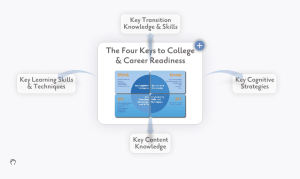
College & Career Ready?

What does that mean?  Explore the graphic organizer below to see the brainstorm results of K-12 educators as we explore this question based on the article “A Complete Definition of College and Career Readiness” by David T. Conley.  This session was hosted by Indiana State University’s Sycamore Educator’s Day.  Please post your thoughts below!

click the graphic to explore

click the graphic to explore

Social Training Wheels

I’m listening to a great presentation about digital citizenship, and it just makes me feel like I need to reblog this post. If you’re on the other side of this opinion and/or on the fence, go check out this Prezi by Kris Reed. http://prezi.com/n5lj0veqpukm/?utm_campaign=share&utm_medium=copy&rc=ex0share

Rachel's avatarAwaken

Hand holding a Social Media 3d Sphere

Should teachers and students be Facebook friends?  Is it ok for a student and teachers to Tweet with each other?  I have been involved in these discussions so many times and I see valid points in both sides of the argument.
On one hand….
Has there ever been a case of inappropriate relationships between teachers and students that couldn’t be traced back to a social media connection?  There’s a lot of bad stuff out there and such tools are a distraction from learning at the least and a potential for real harm at worst.  How would you monitor and control it?  You can’t.  You can only teach students what is right and the respond when they choose to do otherwise.  There are other tools, such as MBC, that offer the same social components but provide the safety net that can protect students while also teaching them to behave appropriately.
On…

View original post 566 more words

“I Hate Math”

Ever hear these words coming from your students?  Many develop a dislike for math through the years that has a negative, circular effect on their learning.  They don’t like math, and math doesn’t like them.  Although they may actually have good mathematical reasoning and computation skills, they may never experience success because of this barrier.

Stanford University has developed a course that helps change this – “How to Learn Math”.  It is an online course for k-12 teachers and parents to help them know how to improve student engagement with math.  The course began July 15, but will likely be offered again given the 20,000 people who have already enrolled.   During the 2012-2013 school year, Stanford will offer a student version of this course as well.

Follow the link below for more information.  There are some other great articles on this site that you may find helpful!

Screen Shot 2013-07-16 at 9.35.26 AM