Lexile Ladder Contest!!!!
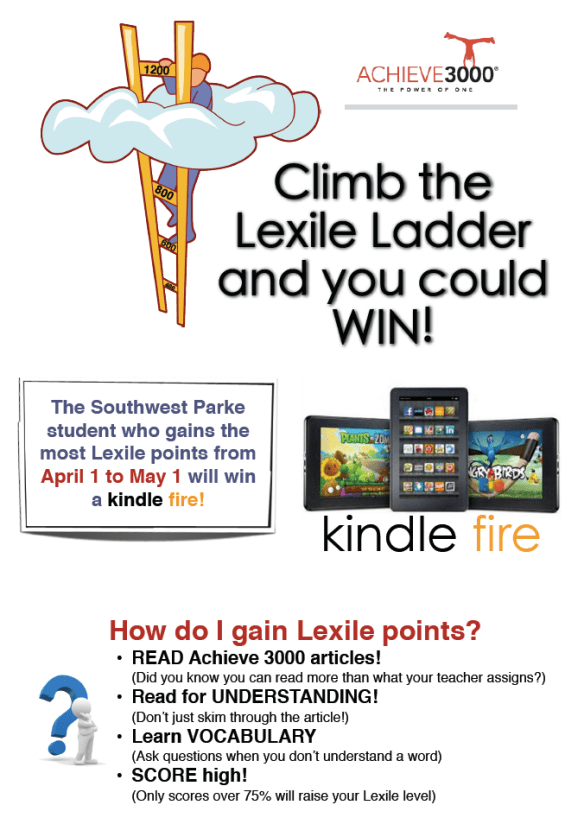
The SWP student who gains the most Lexile points April 1 – May 1 will win a Kindle Fire!

Contest Questions? Post a reply, e-mail or write Mrs. Porter on My Big Campus!

Lexile Ladder Contest!!!!
The SWP student who gains the most Lexile points April 1 – May 1 will win a Kindle Fire!
Contest Questions? Post a reply, e-mail or write Mrs. Porter on My Big Campus!
This chapter shares the differences between a Professional Learning Community, a Personal Learning Network and a Community of Practice and discusses how these three “prongs” together lead create model for Connected Learning Communities.
Professional Learning Communities: Southwest Parke has been a PLC for many years and I feel that we have carried this concept out well. The chapter did make me think, however, that over the years we have allowed our PLC concept to suffer a little as we have pursued other initiatives and models. Is SWP the PLC we claim to be? Are we still the PLC we once were? I am currently working towards trying to empower more teachers to be building experts in different areas (Common Core, Curriculum Mapping, specific digital content resources and tools, etc.) so that the leadership is more shared and not all driven by me. It isn’t easy, though. Teachers are crazy busy and overwhelmed as it is. But I hope that over time, we can reach a point where every teacher in the school is the “go to” person for something. Although there are many other areas of PLC’s that we should consider, I think we will have arrived at a good place when we can say that. One aspect mentioned that I can absolutely say we are doing well is with our online collaborations. Although I would really love to see more participation from teachers in our discussion boards, it has come a long way from the early days of our journey. Visit the SWP Digital Curriculum Group on MBC to see what we do!
Personal Learning Network – Where PLC’s are all about connecting as a team, school and district, a PLN is more about connecting outside of those circles to grow your own individual professionalism with inspiration from a wider range of educators. This is where technology has really changed the world of professional development. Teachers can now take charge of their own learning towards better practice. I have to thank My Big Campus, Twitter, and the IDOE Office of E-Learning for helping my PLN to explode over the last 18 months. The people I have “met” and learned from have been amazing and I cannot encourage educators enough to start building these connections and getting involved. If you’re reading this, you are probably the sort of person I want to connect with. Here’s some links to get you started:
Community of Practice – The book defines CoP’s this way:
“According to cognitive anthropologist Etienne Wenger (1998), communities of practice have three distinct criteria: (1) a shared domain of interest, (2) collective competence among equals who are skillful and talented, and (3) a shared practice or a common sense of purpose. Members of a community of practice are situated practitioners. Communities of practice are made up of people with a common interest, who collaborate to learn to do it better.
Nussbaum-Beach, Sheryl; Ritter Hall, Lani (2011-11-01). The Connected Educator: Learning and Leading in a Digital Age (Kindle Locations 766-769). Ingram Distribution. Kindle Edition.
I feel like my PLN is leading to a CoP. In fact, there is an opportunity on the horizon (forgive the “Awaken” theme play-on-words) that would create an amazing CoP for Southwest Parke Schools. I’m excited about the prospects for learning – both for my own professional growth and for the ways it would impact students and teachers across the state.
~~~~~~~~~~~~~~~~~~~~~~~~
I’m wondering if this blog-about-the-book I’m reading idea was a good one. If you’re still reading… bless you. I realize that not everyone wants to read my thoughts-turned-to print. But…. that’s the idea behind a blog, right? No one is forcing anyone to read this, and maybe…. just maybe… finding this page will make you and I both become a more connected educator. But I really hate blogs that just seem to be someone’s attempt to show how much they know. I don’t want this to be that. So… I want to hear from you! Post a comment below or follow me on Twitter and let’s talk! Be part of my PLN and we can help each other’s PLC’s grow, and maybe we’ll find ourselves part of the same CoP someday… OK? 😉
 Let me first say that foreign languages are NOT my gift. I took four years of French in high school, earned straight A’s but can barely remember how to say “Je m’appelle Rachel” (ok… I confess… I Googled that to make sure I spelled it right, so you get my point.) My teacher just didn’t hold us accountable for our learning or have very high expectations, and it doesn’t come naturally to me. I’m thinking I might be fluent in French to this day, however, if I had the good fortune to be born in the digital age and could have used DuoLingo while she repeated her stories of trips to France.
DuoLingo is a “free service that helps you learn languages with your friends while simultaneously contributing to translate real-world content from the Web.” With it you can learn… for free…. French, Spanish, German, Italian or Portuguese. Check out the explanation video:
Before I suggested it to our foreign language teachers, I gave it a try myself to learn about it’s features. Amazing. DuoLingo started me out with very simple vocabulary aided by visual and audible cues. I had to pay attention, though. It wasn’t long before it asked me to type a word I had just learned with no help! It challenged me even more when I had to record myself pronouncing the words I was learning. There’s a gaming aspect to it too. When you mess up (which I did), you lose hearts. If you lose all of your hearts you have to start the lesson over. It’s a powerful component. It also incorporates social interaction by allowing you to friend other users.
At the end of the lesson you’ll see a chart of the strength of your learning for each word in you’ve worked on. You’ll progress your way through a skill tree and more advanced learners can test out of the lower levels. DuoLingo isn’t specifically designed for classrooms, but I think a teacher could easily “Friend” each of his/her students and use the skill progress to monitor learning. I’ve only recently introduced this to our foreign language teachers, but when they’ve had a little more time using it in class I’ll ask one of them to guest blog about it.
A little time spent on the concept of how your lessons help translate the web, and using DuoLingo could even be considered Project Based Learning in a sense. Students are learning a language while also contributing to a global task of making webpages from all over the world readable in many languages. That’s so cool.
Look out, world! I may just manage to learn another language after all!
 Awaken