 About a year and a half ago, I published some exciting data about the effectiveness of our reading intervention program Achieve 3000, which was relatively new to us at the time. (click here to read “It’s Working – Feb 2013”). We were thrilled with the results we were getting with this tool, closing the gaps in our students’ Lexiles to an even greater extent than promised. So here we are, much further down the road, having invested significant classroom time, professional development and money into this resource. Is it still working? Has it been worth it?
Yes.
Our students just took their third consecutive Level Set test to determine their start-of-school reading level. Using Achieve’s robust data reporting, I was able to track students as they progressed through grade levels. The graphs give me goose bumps… and not just because I’m a data-loving geek! Although we also monitor each grade level from year-to-year to measure the effectiveness of our instruction and implementation, I wanted to track the same group of students over the years they have been using Achieve. This would help us know if the improvements we see over a school year really stick, and their reading levels really are improving. Take a look at our current 6th graders as an example:
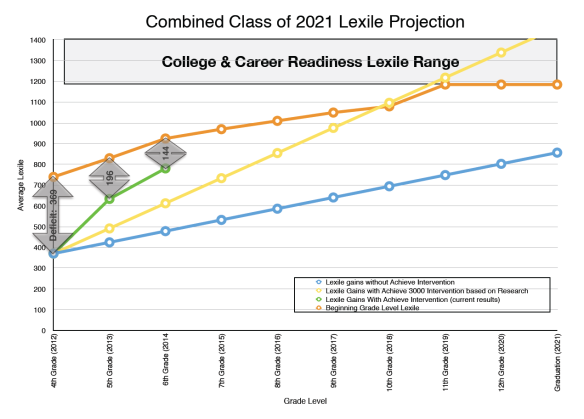
Allow me to explain what we learn from this graph…
- When our students started using Achieve, they tested in 369 Lexile points BELOW their grade level range (orange line). Yikes!
- Tracking normal school year growth without intervention through their senior year (blue line) reveals that they will not graduate ready for college and careers…. not even close.
- According to independent research, proper implementation of the Achieve program will get our students where they need to be by the time they graduate (yellow line)
- And the best part… our results are even better (green line). Our students’ Lexile deficit has closed by 60%! They still aren’t where they need to be, but they are unbelievably closer, and continuing on this track WILL get them ready for college and careers by their senior year.
Another key factor that I wanted to investigate is the cross over from our elementary buildings to our Jr-Sr High school. Historically, student success seems to drop when they move up. Here is the graph for our current 8th graders, who started the program in 6th grade at their elementary schools and have had a full year of using it in each building.
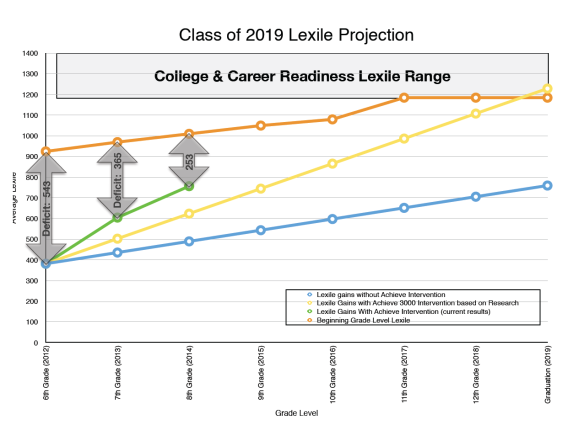 The thing that pleases me the most is how consistently our data holds. With just a couple of minor exceptions, the graphs are very similar from class to class. You can see the full data portfolio here. You may think I’m crazy for getting goose bumps over data like this, but it means that we are doing what is best for our kids. Because we are leveraging technology to provide truly differentiated learning, we are growing students into much better readers. And that will make all the difference in the world for their lives – in school and beyond.
I will be presenting our implementation methods and results with Achieve 3000 at the Indiana Connected Educators Conference in October. If you’d like to know more about the program, how we use it, and our results I hope will you will come see me!



 Awaken